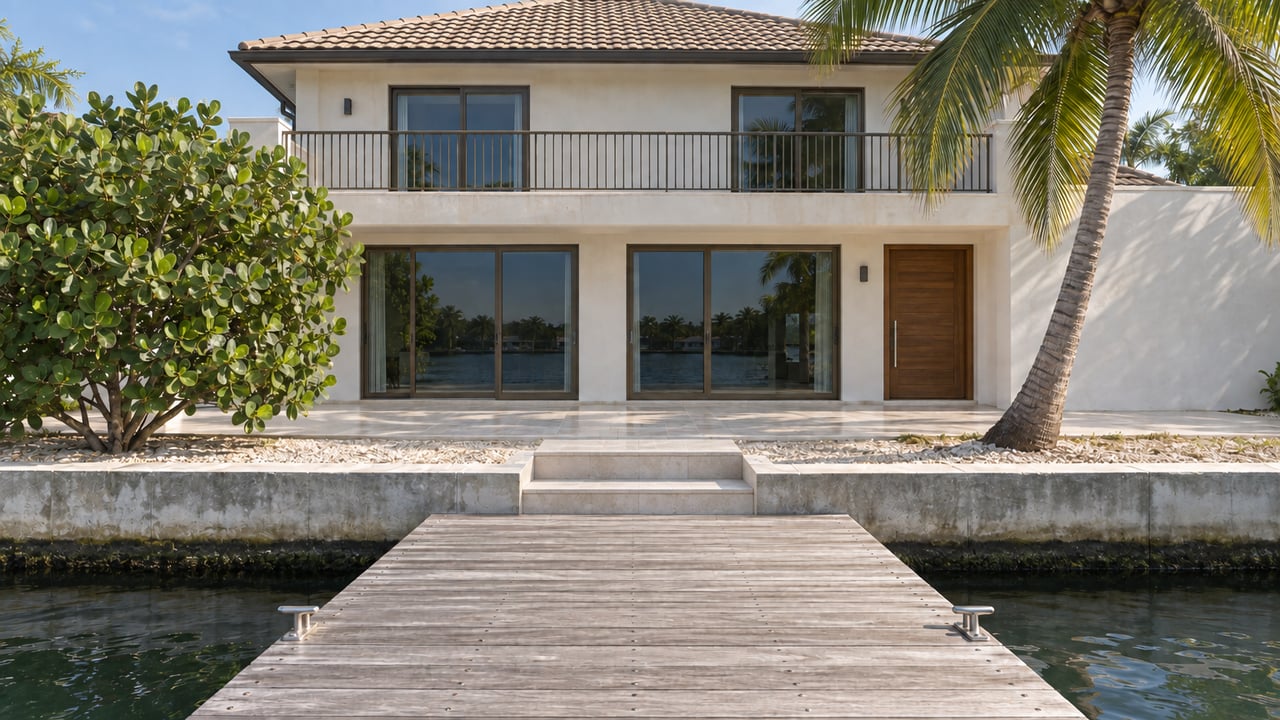
Two canal homes in North Naples can carry the same asking price, the same square footage, and the same phrase in the listing description: Gulf access. One owner can idle out to Wiggins Pass any time the tide allows. The other has to check a tide chart before deciding whether the boat clears the bridge between the dock and open water. Neither home is misrepresented. The phrase just isn't specific enough to tell you which situation you're buying into.
"Gulf access" in North Naples bundles three separate facts that never show up as a single line item: whether a fixed bridge sits between the dock and Wiggins Pass, what the tide is doing under that bridge at the moment a boat needs to pass, and how deep the channel actually runs at low water. A buyer who prices two waterfront homes off the median and the dock length alone is missing the variable that determines whether the boat they already own, or the one they're planning to buy, can actually leave the property.
A Bridge Doesn't Have One Height
A fixed bridge posted with ten feet of clearance doesn't offer ten feet all day. Tide moves that number. A bridge that clears ten feet at low tide can drop to seven feet at high tide, and the number that matters for planning a purchase is the clearance at mean high water, not the figure painted on the piling. For a small center console, that swing rarely matters. For a sailboat with a fixed mast, or a flybridge cruiser, or anything with a tuna tower welded above the deck, a three-foot difference is the line between a boat that lives at the dock and one that's trapped there twice a day.
This is why the same word, Gulf access, means something different depending on which side of a bridge a property sits.
One Bridge: The Conners at Vanderbilt Beach
The Conners at Vanderbilt Beach is a finger-canal neighborhood in North Naples where the route to the Gulf runs through Wiggins Pass, with one fixed bridge along the way. Canal-front homes here have priced from around a million dollars in 2026, which puts the neighborhood at the accessible end of North Naples waterfront ownership. The tradeoff for that price point is the bridge. A boat that fits under it at the tide you're likely to use has no problem. A boat that doesn't will spend more time waiting for a tide window than actually running the pass.
No Bridge At All: Gulf Harbor
Gulf Harbor, off Wiggins Pass Road, sits along the Cocohatchee River and its canal system, and homes there reach open water with no inland detour, running past mangrove preserve along the way.
Gulf Harbor removes the one variable that a bridge imposes on other canal communities in North Naples: a hard limit on air draft that no amount of money can raise, because the bridge belongs to the county or the state, not to any single homeowner.
Access By Marina: Pelican Isle
Pelican Isle takes a third approach. It sits on a 15-acre island in Wiggins Bay, with three eleven-story residential towers totaling 136 condominium units, and an on-site marina with 190 slips that accommodates boats up to roughly 55 feet. The run from the marina to open water through Wiggins Pass takes about ten minutes. Here, a buyer isn't purchasing a private dock and inheriting a seawall. They're purchasing a residence with managed marina infrastructure attached, which shifts the maintenance and depth questions from the individual owner to the marina operator.
Why the No-Bridge Premium Doesn't Fade
A pool can be added. A dock can be extended. A seawall can be rebuilt. A fixed bridge cannot be quietly removed by a homeowner, an HOA, or even a developer, because it's public infrastructure serving an entire waterway, not one property. That's what makes the price gap between bridge and no-bridge waterfront durable in a way that most amenity premiums aren't. A renovated kitchen depreciates the moment trends shift. A canal route with no bridge in it keeps its advantage regardless of what happens to interior finishes, because the constraint it removes is physical, not aesthetic.
That doesn't mean every no-bridge home outprices every bridge home dollar for dollar. It means the ceiling on vessel size and type is fixed at closing in a way a buyer can plan around for as long as they own the property.
The Depth Question a Bridge Can't Answer
Removing the bridge from the equation solves the height problem. It doesn't solve the depth problem. Most residential canals in North Naples comfortably handle boats with a shallow draft of two to three feet. A deeper-draft vessel, a boat with a deep-V hull or a larger cruiser, needs the controlling depth of the specific canal channel at extreme low tide, not the depth quoted at the dock itself. Older canals can also silt up over time, and a buyer planning to keep a larger boat should ask when the county or the community last dredged the channel, because a canal that hasn't been maintained in years can quietly narrow the boats it can actually support.
Collier County's Cocohatchee River Park, a seven-acre public facility on Vanderbilt Drive with four boat-launching lanes, offers a useful real-world benchmark: the run from that ramp out through Wiggins Pass to open water typically takes ten to fifteen minutes. A buyer comparing a private dock's stated run time to the Gulf can use that public ramp as a sanity check before taking a listing's estimate at face value.
What to Confirm Before Writing an Offer
- The mean high water clearance on every bridge between the dock and Wiggins Pass, not the number posted on the structure
- The controlling depth of the canal at mean low water, not just the depth measured at the dock
- The last dredge date for the canal, from the county or the homeowners association
- The age and condition of the seawall, since repair or replacement is a separate capital expense that can run into the tens of thousands of dollars and isn't covered by a standard homeowners policy
None of these appear as a standard field in a listing sheet. All four determine whether the boat a buyer owns today, or plans to buy next season, can actually use the water the home is sold on.
A Few Questions Worth Asking Directly
Does every North Naples waterfront home have direct Gulf access? No. Communities like the Conners at Vanderbilt Beach route through a single fixed bridge to reach Wiggins Pass, while Gulf Harbor has no bridge in the route at all.
Is a home with a bridge in the route a worse buy? Not automatically. It depends entirely on the vessel. A boat that clears the bridge comfortably at the tides you'll actually use loses nothing by being on the bridge side. A sailboat or a flybridge cruiser with a fixed high air draft is the buyer this distinction matters most for.
How do I check a canal's real depth before making an offer? Ask for the controlling depth at mean low water, not the depth quoted at the dock, and confirm it with a marine survey rather than relying on the listing description alone.
Boats and bridges aside, the underlying lesson holds for any North Naples waterfront search: the price on the sign tells you what the house costs. It doesn't tell you what the water will let you do with it.
If you're comparing North Naples docks and want the bridge, tide, and depth details worked out before you write an offer, William Ross can walk the water with you before you walk the house.
This article is general information, not legal, tax or financial advice. Consult a qualified professional about your situation.