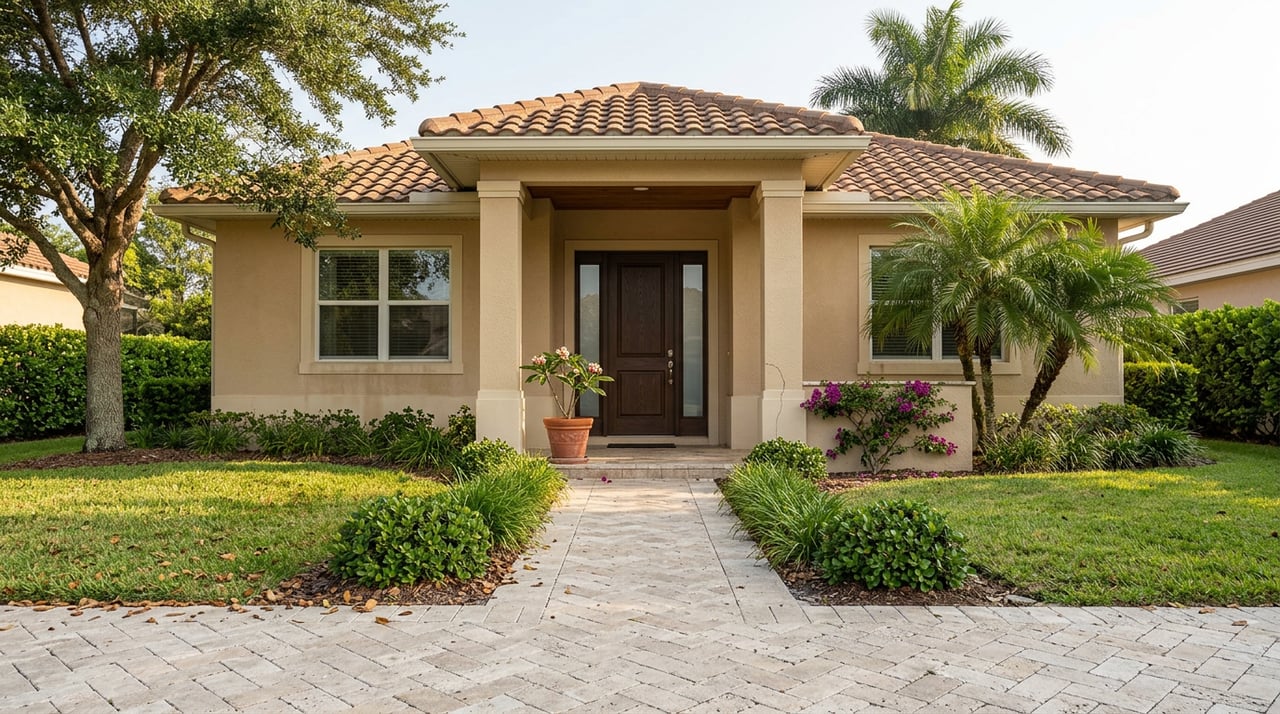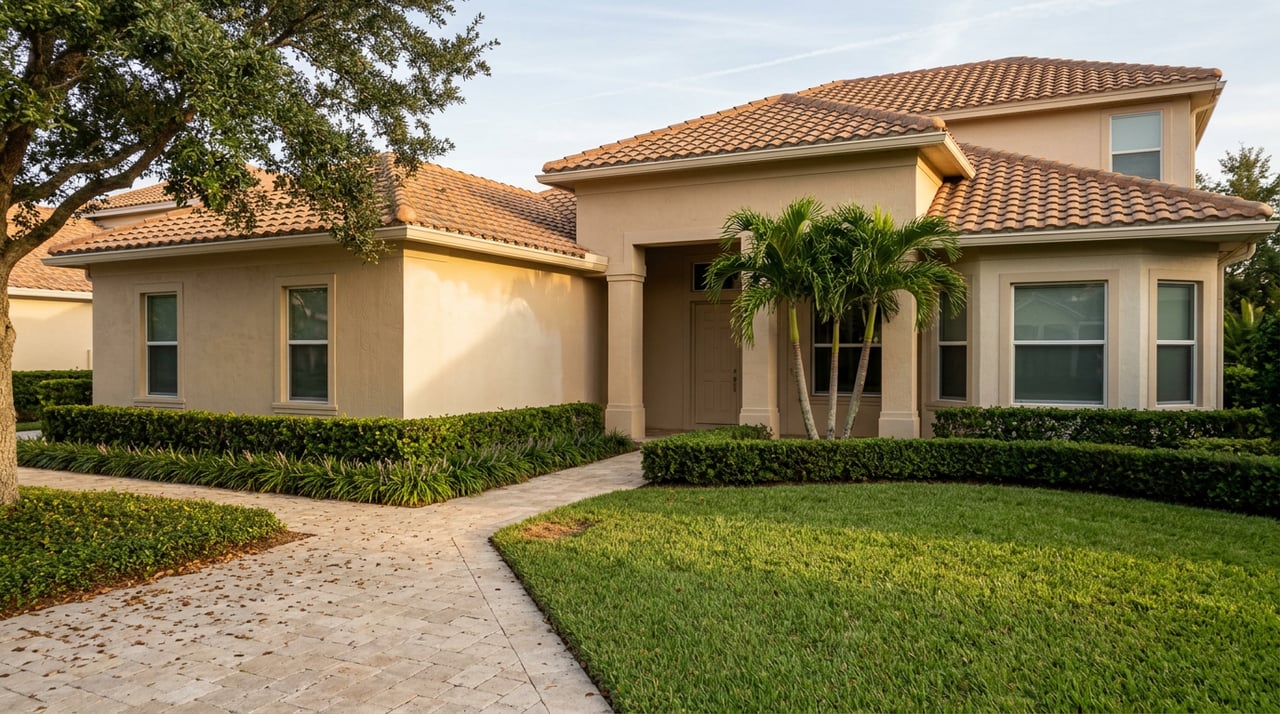
Picture two homes going under contract the same week in Verdana Village. Same builder, same phase, similar square footage, prices close enough that a buyer touring both would call them comparable. One sits on a 36-foot lot. The other sits on a 66-foot lot. Neither buyer thinks twice about lot width during the walkthrough. Then the first property tax bill arrives, and the two owners are paying different fixed annual assessments that have nothing to do with what either of them offered for the house.
That difference is the Community Development District line, and it behaves in a way that surprises even buyers who did their homework on Estero's HOA fees. Most comparison-stage buyers price out the monthly HOA number, maybe ask about a food and beverage minimum, and assume they've found the real carrying cost. The CDD assessment sits somewhere they didn't look, tied to a variable they didn't think to ask about.
The Line That Isn't on the HOA Sheet
A Community Development District is a local government unit created under Florida law to finance and maintain the roads, water management systems, and amenity infrastructure inside a master-planned community. The district issues bonds to pay for that construction, then collects the debt service back from property owners as an annual assessment. That assessment lands on the Lee County property tax bill under the non-ad valorem section, not on the HOA invoice, which is why it's easy for a buyer to budget the HOA fee carefully and still miss a few thousand dollars a year in obligations sitting one line further down the bill.
The Village of Estero itself keeps a low municipal millage rate, which can create a false sense of security about total carrying cost. A low base tax rate says nothing about what sits in the non-ad valorem section underneath it. In a district with an active CDD, that section can add more to the annual bill than the municipal tax itself.
What the Fee Sheet Actually Shows
The clearest evidence of how this scales comes straight from Verdana Village's own published fee documents. The 2025 fee summary for one of its neighborhood associations breaks the CDD assessment down by lot width, combining bond debt service with operating and maintenance costs into a single total:
| Lot Width | Debt Assessment | O&M Assessment | Total Annual CDD |
|---|---|---|---|
| 36' Lot Home | $1,170.00 | $149.15 | $1,319.15 |
| 42' Lot Home | $1,365.00 | $161.60 | $1,526.60 |
| 52' Lot Home | $1,690.00 | $182.34 | $1,872.34 |
| 62' Lot Home | $2,015.00 | $203.09 | $2,218.09 |
| 66' Lot Home | $2,145.00 | $211.38 | $2,356.38 |
The gap between the smallest and largest lot in this one fee sheet runs over $1,000 a year, which works out to roughly $86 a month. That gap tracks the physical footprint of the lot the home sits on, not the closing price. A buyer who negotiates the purchase price down $10,000 has done nothing to change this number. A buyer who chooses the narrower lot to save on the sale price is also, whether they realize it or not, locking in a lower fixed assessment for as long as they own the home.
Same Community, Same Amenities, Different Bill
This is the part that catches people off guard during a side-by-side comparison. Two owners in the same Verdana Village neighborhood, using the same clubhouse, the same resort pool, the same indoor sports complex, can be carrying meaningfully different fixed costs purely because of the lot they picked. It isn't a reflection of a better location or a nicer view. It's a function of how the original bond was structured and allocated across lot sizes when the district was created.
The debt service portion of that number is fixed on a schedule until the underlying bonds mature or get paid off early, typically over a 20 to 30 year term. The O&M portion is different. It gets set annually by the district's board of supervisors at a public budget hearing, which means it can move year over year based on the community's operating costs even when the debt payment stays flat. Comparing an older fee sheet to a newer one for the same lot width shows that O&M creeping upward is normal, not a sign anything went wrong.
The Fee Word Means Something Different at Each Estero Address
Buyers cross-shopping Estero communities run into a second layer of the same problem: "HOA fee" doesn't mean the same bundle of charges from one gate to the next.
- Grandezza, next to Miromar Outlets, runs a master association fee of roughly $350 to $400 a month, with separate sub-association fees layered on depending on the specific product type.
- West Bay Club, west of US-41, carries a base master fee of about $445 a month, a structure built around its private beach and marina access.
- The Place at Corkscrew stacks a master HOA fee in the $300 to $450 a month range with its own CDD assessment on top, plus an annual food and beverage minimum tied to its resort-style pool and dining program.
None of these numbers is wrong, and none of them is directly comparable to the others without pulling apart what each one actually covers. A $445 base fee that includes exterior insurance and full amenity access can be a better deal than a $300 fee that leaves CDD debt service and a beverage minimum as separate line items still to come. The only way to know is to ask what's bundled and what isn't, community by community.
Why the Timing Matters More at Closing Than at the Open House
The CDD assessment behaves differently at resale than most buyers expect. Because it's a government-issued bond obligation tied to the property rather than the person who owns it, the remaining balance doesn't reset when a home changes hands and doesn't scale up or down with the resale price. A home that sold for $420,000 five years ago and resells today for $520,000 still carries whatever remains of the original bond schedule for that lot, unaffected by the price gain in between.
That fixed structure creates room for negotiation that a lot of buyers never raise. Some sellers in CDD communities will agree to pay down or pay off the remaining bond balance as a concession, which removes or reduces the annual assessment for the buyer going forward. It's not standard in every deal, but it's a real lever worth putting on the table, especially in a district where the debt service portion still has a decade or more left on its schedule.
Lenders also treat the CDD assessment as a recurring obligation during underwriting, similar to a fixed debt payment, which means a higher annual CDD number can reduce how much mortgage a buyer qualifies for even if the home's list price fits their budget on paper.
What to Confirm Before You Write an Offer
A few steps turn this from a surprise into a known number before an offer goes in:
- Pull the property's current Lee County tax bill and look at the non-ad valorem section for a CDD line item and dollar amount.
- Ask the seller, builder, or district manager for the current CDD budget and, if one exists, the bond amortization schedule showing the remaining term and balance.
- Confirm whether the community's landscaping, gate staffing, or amenity operations are funded through the CDD, the HOA, or split between the two, so nothing gets double counted in a monthly budget.
- Ask directly whether the seller would consider paying down or paying off the remaining bond balance as part of the negotiation.
- Get the exact lot width or unit type identified in the district's assessment roll, since two homes in the same phase can carry different totals.
A Few Questions Worth Asking Directly
Does the CDD fee ever go away? The operating and maintenance portion continues as long as the district exists, since it funds ongoing upkeep of shared infrastructure. The debt service portion ends once the bonds tied to that lot are paid off or defeased, which is a fixed schedule rather than something that phases out gradually.
Can a homeowner refuse to pay it? No. The assessment is a government-authorized lien on the property, not a private contract like an HOA fee, and it applies uniformly to every parcel in the district regardless of individual preference.
Is the CDD fee tax deductible? Generally not. Because it funds specific local improvements rather than general government services, it's typically treated differently than standard ad valorem property taxes for federal deduction purposes. Anyone relying on this for tax planning should confirm current treatment with a tax professional.
The sticker price gets all the attention on a listing. The number that actually determines what a home costs to hold for the next ten or twenty years is usually sitting one section down on the tax bill, tied to a lot boundary nobody walked off during the showing. Knowing which questions to ask before an offer, rather than after closing, is the difference between a fixed cost you planned for and one that shows up as a surprise on the first tax bill.
If you're comparing communities in Estero and want the real carrying-cost numbers pulled together for the specific homes on your list, William Ross can walk through the fee sheets, bond schedules, and HOA structures side by side. Let's Connect.