Pull three different market reports on Park Shore this week and you'll get three different numbers for the same thing. One shows the median sale price per square foot at $693, up nearly 8 percent from a year ago, based on the trailing three months ending May 2026. Another puts it closer to $969, down slightly from the prior year, based on the most recent month reported. A third, looking at beachfront condos only across the broader Gulf Shore Boulevard corridor that includes Park Shore, the Moorings, and Coquina Sands, lands at $913 over the trailing twelve months ending June 2026, with a median sale price of $1,725,000.
None of these numbers are wrong. They're measuring different things. One blends single-family homes on Venetian Bay canals in with beachfront towers. Another looks at condos alone in a single recent month, which in a market this thin can swing on a handful of closings. The third stretches the lens out to a full year and widens the geography to three adjacent neighborhoods.
That's a real explanation, and if you stopped there you'd have a perfectly good answer to why the numbers disagree. But it's not the answer that matters if you're actually shopping for a unit right now. The bigger driver of what two similarly sized Park Shore condos will actually cost you to own over the next five years isn't square footage, floor, or even view corridor. It's which side of Florida's structural reserve deadline the building's association is standing on.
Why the Numbers Diverge, at a Glance
| Data pull | Time window | What's included | Price per sq ft |
|---|---|---|---|
| Neighborhood-wide report | 3 months ending May 2026 | All Park Shore sales, condos and single-family combined | $693 |
| Recent monthly snapshot | Most recent month reported | Park Shore condos only | $969 |
| Corridor closed-sale count | Trailing 12 months ending June 2026 | Beachfront condos only, Park Shore blended with the Moorings and Coquina Sands | $913 |
Each of these is defensible. None of them tells you what's happening inside a specific tower's reserve account, and in Park Shore right now, that's the number that separates a good deal from an expensive surprise.
The Deadline That's Already Behind Us
Florida's structural integrity reserve study requirement isn't new legislation anymore. It's a compliance clock that's already run out for most buildings. Under the framework the state's Division of Condominiums lays out, associations that existed on or before July 1, 2022 and are unit-owner controlled were required to have a completed Structural Integrity Reserve Study by December 31, 2025. The one carve-out: if a building's milestone structural inspection isn't due until on or before December 31, 2026, the association can complete its SIRS at the same time as that inspection, but no later than the 2026 date either way.
What that means as of this month, August 2026, is straightforward. Most Park Shore associations should already have a completed SIRS in hand. Reserve funding tied to those studies started January 1, 2026, so buildings that finished their study are now roughly seven months into actually paying for whatever it told them to save for. A building still working through its milestone inspection on the later 2026 track hasn't hit that funding requirement yet, which means the bill, if there is one, is still ahead of it rather than behind it.
Age is what puts a building on one track or the other. Milestone inspections apply to condominium and cooperative buildings three or more habitable stories in height once they reach 30 years of age, with local building departments near the coast, including in Naples, generally setting that trigger five years earlier for buildings closer to the Gulf. Park Shore's condo stock runs from the 1960s through the post-2000s, which means the neighborhood right now has buildings on every point of this timeline at once. That spread, more than view or unit size, is what's driving the price-per-square-foot numbers apart.
What That Looks Like Building by Building
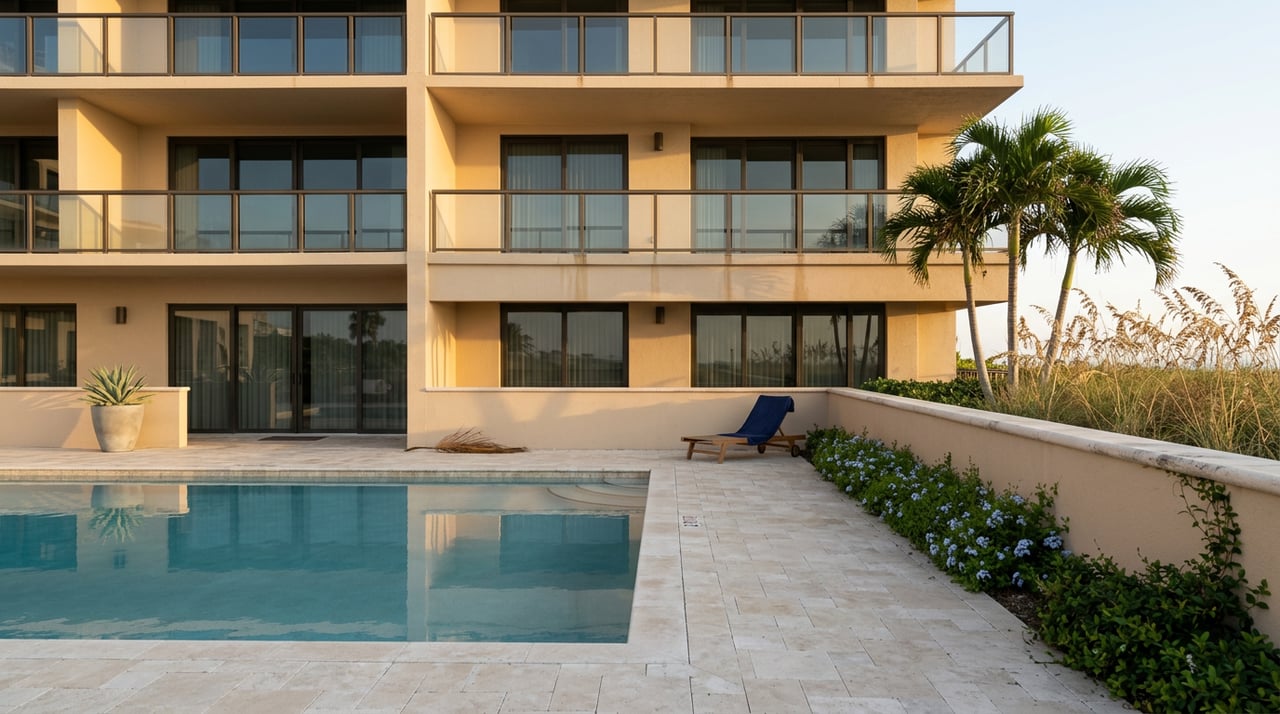
Vistas at Park Shore is a useful example of what a clean outcome looks like. The 20-story, 131-unit tower was completed in 1990, which put it well inside the window for both a milestone inspection and a SIRS. The association has completed both, and because of what its listings describe as disciplined reserve funding, no special assessment was needed to meet the study's recommendations. The building is now mid-renovation, with an exterior repaint to white and bronze window trim, new panoramic lanai screens, aluminum cable railings, and a full remaster of the lobby, social room, library, and all 21 residential hallways, targeted for completion in summer and fall of 2026.
Horizon House tells a similar story from a different angle. The building finished a comprehensive renovation in October 2025 that included all-new electric and a full replacement of its galvanized piping. Its milestone inspection is complete, and no special assessments have been identified for future owners.
Park Shore Tower, completed in 1985 as a 20-story, 75-unit building, is currently being marketed with assessments paid in full following a 2025 renovation that included new paint and electrical work. Monthly HOA fees across the building's unit types currently run in the range of roughly $2,800 to $3,200, which reflects a full-service tower with insurance, ground maintenance, and building systems all carried in the dues rather than pushed into a future special assessment.
Three different buildings, three different ages, and three different paths to the same result: an association that's already done the work, priced it, and funded it. That's the kind of detail a neighborhood-wide average can't show you, but it's the single biggest variable in what a specific unit will actually cost you to own.
What to Ask For Before You Write an Offer
Every structural inspection report and reserve study is required by state rule to sit in a condominium association's official records and be provided to a prospective buyer. That means you're entitled to ask for the documents directly rather than relying on what a listing description summarizes. Before you write an offer on a Park Shore condo, request:
- The completed milestone inspection report, including the Phase 2 findings if the building triggered one
- The current Structural Integrity Reserve Study and its funding schedule
- Whether the association has paused or reduced reserve contributions, which Florida law allows for up to two consecutive budget years if a milestone inspection identified repairs and the membership approved the pause
- Confirmation of any special assessment already levied, and its per-unit dollar amount
- The most recent board meeting minutes covering the inspection or reserve study discussion
If a listing simply says "milestone inspection complete," that's a start, not an answer. The reserve study is where the real cost picture lives.
What This Means for Comparing Buildings, Not Just Units
Wider Collier County context helps frame the pace you're working with. The Naples Area Board of Realtors reported roughly 6,367 active listings, 1,394 pending sales, and 1,054 closed sales countywide in March 2026, with properties averaging 95 days on market. That's not a market where speed matters more than getting the underwriting right, and Park Shore, with its finite and aging condo stock, is exactly the kind of place where taking the extra week to pull documents pays off.
A unit priced a little higher per square foot in a building that has already cleared its SIRS with no assessment, the way Vistas and Horizon House have, may carry a more predictable five-year cost than a unit priced lower in a building whose reserve study hasn't landed yet. The lower number on the listing sheet isn't automatically the better deal. It might just be a bill that hasn't arrived.
A Few Questions Worth Asking Directly
Does this apply to every property in Park Shore, or just the condo towers? The milestone inspection and SIRS requirements apply specifically to condominium and cooperative buildings three or more habitable stories in height. Single-family homes and Park Shore's mid-rise buildings under three stories fall outside this framework entirely.
If a building hasn't hit the 25 or 30-year mark yet, is it exempt from this conversation? For now, yes, but Park Shore's post-2000 towers will start entering this same window over the next decade. Asking about a building's age and expected inspection timeline is worth doing even in newer construction, since it tells you how far out the next reserve conversation is.
Where do I actually find whether a specific building has completed its SIRS? Ask your agent to request the report directly from the association or its property manager. State rule requires these documents to be part of the association's official records and made available to a prospective purchaser, so a request shouldn't be met with resistance.
If you're comparing specific Park Shore towers and want a second set of eyes on what a building's inspection history and reserve position actually mean for your offer, William Ross has spent years tracking these buildings up close. Let's Connect and walk through the documents before you write anything.