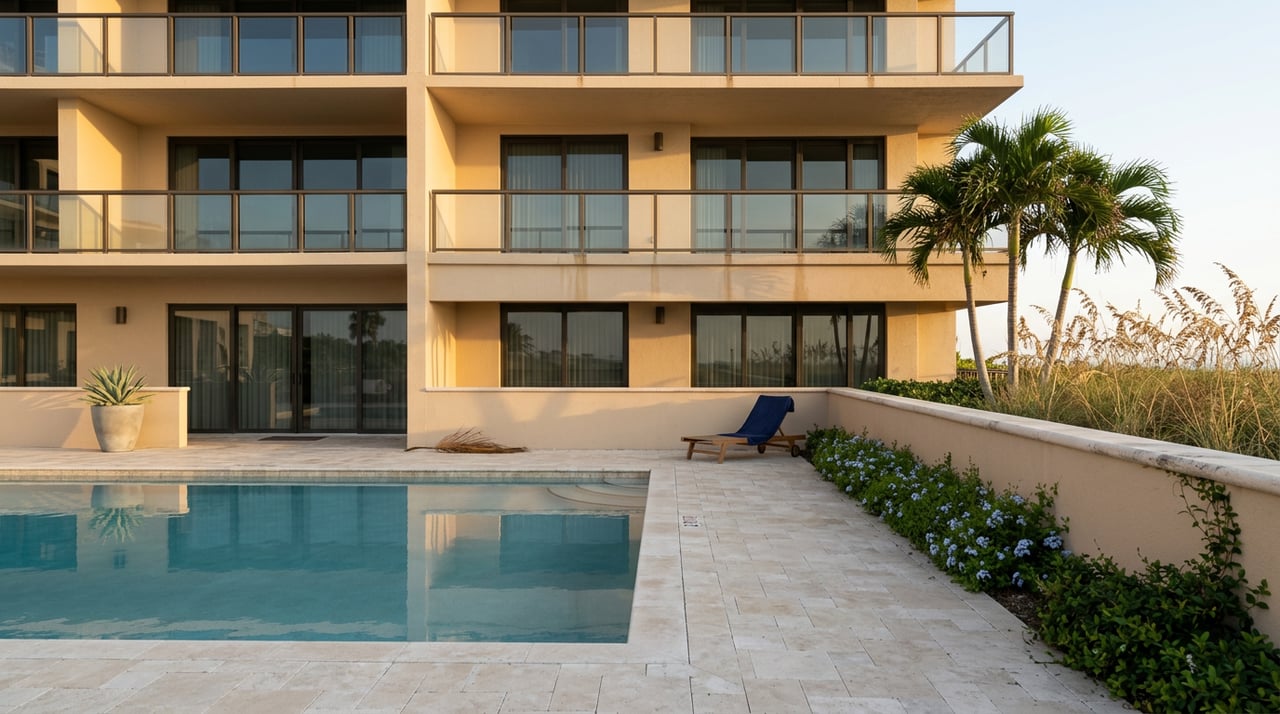
A buyer sits down at the closing table for a $1.6 million Pelican Bay condo, mortgage approved, inspection cleared, wire sent. Then the settlement statement lands on a line neither the listing agent nor the portal search mentioned: a $10,000 Resale Capital Assessment, payable to the Pelican Bay Foundation, due today, not negotiable.
It is not a hidden fee. It is printed in every current estoppel package. But it rarely shows up in the number a buyer has been carrying around in their head since they started browsing, because that number came from a median sale price, and a median sale price in Pelican Bay describes the sticker, not the bill.
Here is the claim worth sitting with before you write an offer in this North Naples community: two units that look identical on paper, same building, same square footage, same list price, can carry meaningfully different true costs to own, because Pelican Bay's amenity system is not one fee. It is four, run by different organizations, and almost none of them appear in a portal's headline number.
Four Governments, One Beach
Start with what a "private beach" actually means here. Nearly three miles of Gulf shoreline sit behind Pelican Bay's boardwalks, reachable by an open-air electric tram running along a raised berm through the mangroves. That system is not run by the county and it is not run by a single condo board. It is run by the Pelican Bay Foundation, the master homeowners association that every property owner in the community must join, and it is separately shadowed by the Pelican Bay Services Division, a Collier County government unit created under county ordinance to fund things the Foundation does not touch.
The split sounds bureaucratic until you see what each side actually pays for. The Foundation's current annual assessment runs $3,295 per year, billed in quarterly installments of $823.75, and that money funds the tram fleet, the beach attendants, court time, the fitness center, and the community center. The Services Division, by contrast, is the reason your county tax bill carries a non-ad valorem line item most buyers have never noticed before closing. It funds street lighting, stormwater management, and the beach renourishment and Clam Bay dredging work that keeps the sand under the boardwalks from washing away. The most recently published rate ran $1,550 per Equivalent Residential Unit, set through Collier County's own annual budget hearing process rather than through anything the Foundation controls, which is why the two numbers on your closing documents can move independently of each other from one year to the next.
Neither of those numbers includes the fee your specific building charges for its own pool, roof reserve, or lobby staffing. Pelican Bay is not one association. It is roughly 95 of them, each setting its own dues independently.
What the Fee Stack Actually Looks Like
| Layer | Who runs it | What it funds | Rough current figure |
|---|---|---|---|
| Pelican Bay Foundation | Master HOA, mandatory for all owners | Tram, beach attendants, tennis, fitness, community center | $3,295/year, billed quarterly |
| Resale Capital Assessment | Pelican Bay Foundation | One-time buyer-paid fee at closing | $10,000 |
| Pelican Bay Services Division (PBSD) | Collier County government (MSTBU) | Beach renourishment, stormwater, street lighting, Clam Bay maintenance | $1,550 per ERU, most recently published rate, reset annually |
| Building HOA | One of roughly 95 individual associations | Building-specific reserves, insurance, staffing | Varies widely by building |
Read that table as a due diligence checklist, not decoration. The Foundation number is knowable in advance from the FY2026 budget. The resale assessment is fixed and non-negotiable. The PBSD figure requires pulling the actual county assessment roll rather than trusting a secondhand estimate. And the building HOA line is the one that actually separates a $1.6 million unit that is cheap to own from a $1.6 million unit that is not, because it is the only layer priced by the specific building rather than the community as a whole.
None of these four layers includes golf. Club Pelican Bay, the community's 27-hole Arthur Hills course and clubhouse, operates as a fully separate private club with its own membership process. The club's published waitlist terms currently show a $15,000 non-refundable deposit and a $50,000 joining fee, with applications capped at 75. Owning in Pelican Bay buys you the beach, the tram, and the tennis courts. It does not buy you a tee time.
Why the Tram Stop Is a Price Input, Not an Adjective
Once you understand that beach access is bundled into the mandatory Foundation fee rather than sold separately, the marketing language in a listing starts to read differently. When a description mentions a specific tram stop or a walk time to Marker 36 or Sandbar, the two beachfront dining venues the Foundation operates, that is not scenery. It is a cost input, because the tram carries more than 900,000 rides a year across the community's eight stations, and how close your building sits to a stop determines how often you will actually use the amenity you are already paying $3,295 a year for.
This is also where the math can flip in a buyer's favor. Elsewhere in Naples, resort-style beach and club access of this scope is often sold as a separate membership, sometimes with initiation fees in the mid five figures on top of annual dues. In Pelican Bay, that access is mandatory and priced through the Foundation rather than optional and priced through a private club. If your household will genuinely use the beach, tram, tennis, and pavilion dining more than a couple of times a month, the bundled fee structure can work out cheaper than replicating the same access as an add-on somewhere else. If you are buying primarily for the address and rarely leave the building, you are still paying for all of it.
Reading the Sticker Against the Real Number
Recent data makes the gap between headline price and true cost easier to see. As of March 2026, the average home value across the broader North Naples and Pelican Bay corridor tracked by public sale records sat near $954,000, with the median sale price around $891,000, a figure that had actually softened slightly compared to the year before even as price per square foot rose. Zoom into Pelican Bay specifically and the picture shifts higher: average home values there were running above $1.3 million as of the end of March 2026, with a February 2026 median sale price near $1.59 million and homes taking a median of roughly two months to go from listing to pending contract. Across all of 2025, condos in the Gulf-view and bay-facing range averaged close to $2.18 million, single-family homes averaged around $3.62 million, and the year's single top sale reached roughly $15.5 million.
That gap between the wider North Naples median and the Pelican Bay median is not just a location premium. Part of it is the fee stack itself, priced into the sale in advance because buyers know what they are inheriting. A unit in a North Naples building outside Pelican Bay might carry a lower HOA fee and no Foundation assessment, but it also has no tram, no attendant-staffed beach, and no guaranteed dry-sand access at all, since Florida's public beach rights only cover the wet sand below the mean high-water line. Comparing the two requires pricing the alternative, not just the sticker.
What to Actually Ask For Before You Write an Offer
If you are comparing a Pelican Bay listing against another North Naples property, request the current Foundation estoppel and the specific building's HOA financials before you get attached to a number. Ask what the building's roof, pool, and reserve schedule looks like, since that is the layer with the widest range. Confirm the resale capital assessment amount directly, since it can shift year to year and is due from the buyer regardless of what the seller's prior estoppel says. And if proximity to a specific tram stop or beach pavilion matters to how you will actually live there, treat that distance as a line item worth asking your agent to walk with you in person, not just a phrase in a listing description.
A Few Questions Buyers Ask First
Does the Foundation assessment cover golf? No. Club Pelican Bay operates entirely separately, with its own membership application, initiation fee, and dues.
Is the $10,000 resale assessment negotiable? It is set by the Foundation and paid by the buyer at closing. It is not typically a point of negotiation between buyer and seller, though some Foundation rules allow limited exemptions for owners moving between properties within the community.
Why does my tax bill show a separate Pelican Bay line I do not recognize? That is the Pelican Bay Services Division assessment, a Collier County non-ad valorem charge tied to the community's special taxing district. It funds beach renourishment, stormwater, and Clam Bay maintenance, separate from anything the Foundation collects.
Does every Pelican Bay building charge the same HOA fee? No. Each of the roughly 95 sub-associations sets its own dues based on that building's specific reserves, insurance, and staffing needs, which is why two similarly priced units can carry very different monthly costs.
Comparing North Naples communities by median price alone tells you almost nothing about what you will actually pay to own there. If you are weighing Pelican Bay against another coastal pocket of North Naples, or trying to make sense of an estoppel that just landed in your inbox, William Ross can walk through the specific building, the specific fee stack, and what it means for your offer. Let's Connect.