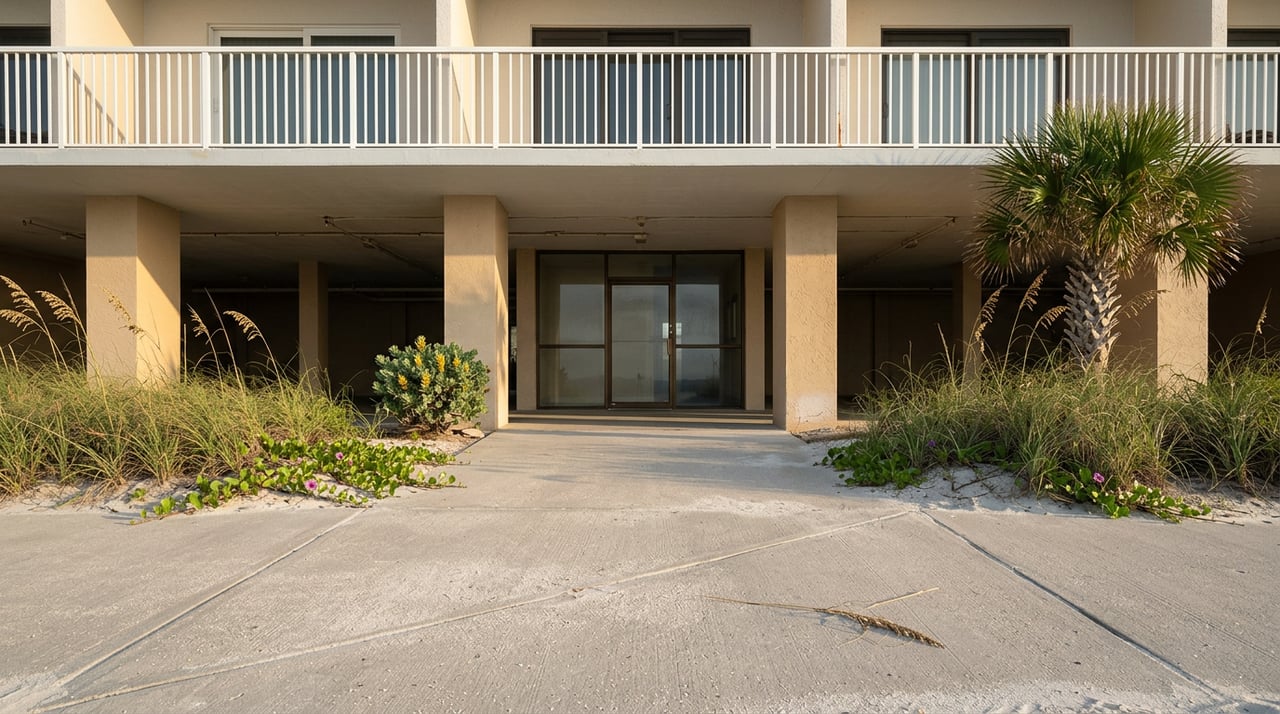
Ask most people who walk the Park Shore promenade every morning who owns it, and you'll get some version of "the city" or "the county." It's paved, it's public-feeling, it runs for over a mile along some of the most photographed beachfront in Naples. Surely someone with a budget and a maintenance crew is behind it.
Nobody is, at least not in the way you'd expect. The beach walk between Horizon House and Le Parc is private property, owned and governed by five separate condominium associations known as the Commons. The Gulf Shore Association of Condominiums, which fields more questions about the walk than any other topic, has said plainly that it has no ownership stake and no governing authority over it. Neither does the City of Naples. That single fact explains almost everything confusing about how the walk has come back since Hurricane Ian, and it explains what's likely to happen next.
Five Associations, One Walkway
The promenade was built by the Lutgert Company in the early 1970s as part of the original Park Shore development, meant for the enjoyment of the condo owners along Gulf Shore Boulevard North. It survived more than 50 years before Ian's 14-foot storm surge tore through sections of it in 2022. What most residents don't register day to day is that the concrete under their feet changes legal ownership every few hundred yards. Each stretch belongs to a different Commons, and each Commons has its own board, its own budget, and its own timeline for getting things fixed:
- Commons R, fronting Surfsedge
- Commons S, between Gulfside and La Mer
- Commons T/U and Commons V
- Commons W, between the Vistas and Le Parc
Nearly 2,000 condominium owners sit across those five boards. When something happens to the walk, from a hurricane to a decision about raising it a few feet, there isn't one meeting where it gets settled. There are five.
What Ian Actually Left Behind
That structure is why the rebuild looked so uneven if you were watching it happen in real time. By August 2023, the southern stretch between Horizon House and Lutgert Park had been fully repaired, benches replaced, concrete poured, roughly a year after Ian hit. The northern segment, running from the Regent up to Le Parc, was still mid-pour that same month, with three separate Commons boards coordinating the work. By February 2024, three of the five associations, R, T/U, and V, had reinstalled their "Private Beach Walk, No Trespassing" signs, the same signs that spell out the walk's long-standing rules against bikes, dogs, and skating. Commons S had signs on order. Commons W was still deciding what it wanted to do.
Then Hurricanes Helene and Milton struck in 2024 and undid parts of that progress, adding fresh damage to sections that had only recently been finished and pushing pieces of the timeline back into a second round of repairs.
The Owners Paid For It, Not the City
Because the walk is private property, the roughly $15 million cost of rebuilding the concrete, dunes, irrigation, and lighting didn't come from a municipal budget or a county bond. It came from assessments billed directly to the condo owners in those five Commons. If you own along this stretch of Gulf Shore Boulevard North, the beach walk outside your building is one of the more expensive shared amenities you're quietly paying to maintain, and the bill arrives on your own association's schedule, not the city's.
The Sand Finally Caught Up
While the concrete work was underway, Collier County ran its own renourishment project to rebuild the beach itself. By January 2025, the scope had grown from an estimated 160,000 tons of sand to 312,000 tons, trucked in from Immokalee, with Horizon Way serving as the staging area and closed to the public for the duration. The goal was to return the beach to its standard 85-foot width, measured from the mean high water mark to the dune line, a width that recent storms had noticeably eaten into.
The native vegetation planted on those rebuilt dunes needed longer to prove itself. According to the Park Shore Association's February 2026 newsletter, the sea oats and native sea grasses installed the previous summer are now visibly established and holding the dune line, the kind of slow-moving good news that doesn't make for dramatic photos but matters more than almost anything else out there when the next storm comes through.
The Next Question Is How High
The most consequential decision hasn't been made yet, and it's a decision about elevation, not repair. Some sections of the promenade already sit higher than others. North of the Park Shore Association's own beach park, the three Commons associations in that stretch built their section of dune and berm to roughly 13 feet, more than double the approximately six-foot elevation in front of the PSA park itself. That difference showed during Helene and Milton, when the taller sections held up better against storm surge and sand loss.
The proposal now under discussion would raise the promenade in front of the PSA beach park to match that taller standard, more than doubling its current elevation by building a substantial berm underneath it. PSA Board President Nancy Walkenhorst has been sitting in on the Commons' planning meetings to keep the association's own plans aligned with whatever the five boards decide. Park designer Christian Andrea has outlined a vision for what the rebuilt park could look like once the berm is in place.
None of it moves quickly. The project needs sign-off from the Florida Department of Environmental Protection and the City of Naples permitting department, and as of the Commons' April 2026 update, it was still described as a study, not a funded plan with a start date. The same structural reality that made the post-Ian repairs patchwork will shape this too. Five boards, five budgets, five votes. Don't expect the berm to rise along the whole 1.2 miles at once, even after it clears every permit. Expect it the way you got your concrete back: one Commons at a time.
A Few Things Haven't Changed
Whatever happens with the berm, the rules on the walk itself are the same ones that have applied for years: no bikes, no dogs, no skating, a fact reflected in signage that's been replaced more than once since 2022. The Park Shore Association's beach park still hosts its own small calendar of neighborhood life around all of this. This year's Easter Egg Hunt drew families to the park on April 4, and the association hosted a Wine Wednesday evening there with the Bubbles Mobile Bar. Its annual photo contest, judged purely on submitted images of the neighborhood, went to Kevin Gough this year for a shot of the sunset offset by a diving pelican, which is as good a summary as any of what people are actually looking at when they're out on that walk in the evening.
The next time someone mentions the beach walk needing work, or asks why one stretch looks freshly poured while another still shows weathering, the answer isn't bureaucratic delay. It's ownership. Five boards are managing one shared asset at their own pace, funded by their own residents, and that's likely to be true again the next time a decision this size comes around.
If you're weighing a move to this stretch of Gulf Shore Boulevard North and want to understand what you'd actually be buying into, from Commons assessments to how a specific building's stretch of the walk has fared, William Ross has spent years watching these details play out block by block. Let's Connect.